






Resources Mentioned in this Episode
Please note that this transcript was auto-generated. We apologize for any minor errors in spelling or grammar.
Jenna Shales: [00:00:00] It’s important to know that the laws that oversee the way that disabilities approached and supported in K through 12 are completely different than the laws that are in play in college. And as a result of those, there are some pretty significant differences. One of the ones that I think folks find most surprising is how student led the processes once a student enrolls in college, right?
So we think about K through 12. We think about, you know, parents or advocates being the ones who are like going to IEP meetings and 5 0 4 meetings, right? And making sure things are getting done. And the second college starts, it’s actually the student’s responsibility, right?
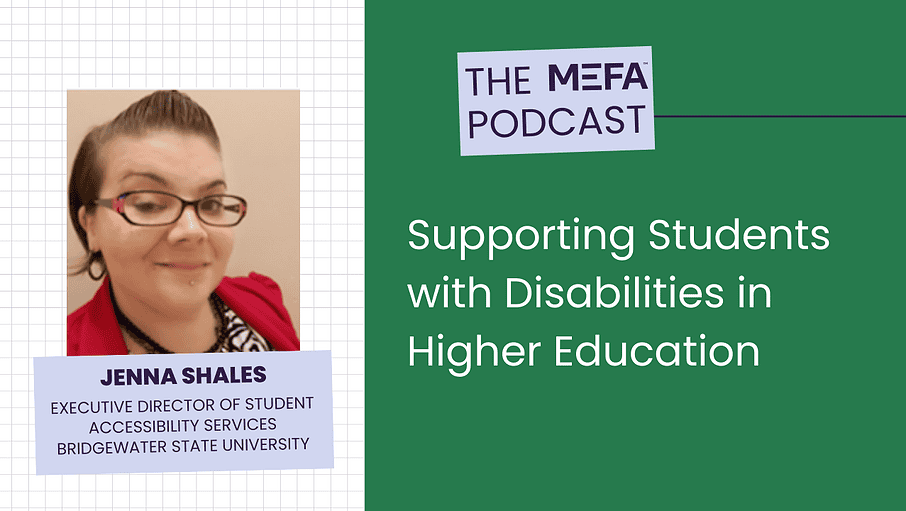
Jonathan Hughes: Hi folks, and welcome to the MEFA [00:01:00] Podcast. My name is Jonathan Hughes, and you just heard from my guest on the show today, Jenna Shales. She’s the Executive Director of Student Accessibility Services at Bridgewater State University. And this show is all about how students with disabilities can find support on college campuses.
And I know that this is a topic that is a concern to many of you. Maybe you are a student on an IEP or 504 plan in high school. Maybe you have a student getting some support like that at high school and you’re heading off to college or maybe thinking about heading off to college. And you’re wondering what kind of supports can you expect from.
Any particular college that you may go to? How can you tell which colleges may offer you the best supports once you’re at college? What should be your first step to continuing the supports that you have? So our guest on the show today is an expert on those questions. She heads the office at Bridgewater State University [00:02:00] that deals with those questions.
So she has a lot of great ideas. We’ll talk about those. And we’ll also talk about how Bridgewater State has made inclusion and access a priority for students with disabilities over the past few years, and the great things that have followed from that. Now, I will be back after the interview to wrap things up, but now let’s meet our guest on the show.
Jenna Shales: I’m Jenna Shales, she/her pronouns. I am the Executive Director of Student Accessibility Services at Bridgewater State University, which is in Bridgewater, Massachusetts.
Jonathan Hughes: So tell me a little bit about student accessibility services then at Bridgewater.
Jenna Shales: Sure. Sure. So student Accessibility Services or SaaS is the re-envisioned version of what used to be called the Disability Resources Office at BSU.
We changed the name about six years ago to reflect a new approach to how we wanted to support students with disabilities. So we used to just do academic accommodations and now we have [00:03:00] expanded to provide accommodations in all aspects of the student experience. So residence life and housing, student clubs and organizations.
So that’s a pretty big deal. We also expanded our peer mentoring program and we made it more social focused based on feedback that we’d gotten from. Students. We’ve also developed and now offer tons of activities and events. Everything from small social gatherings to bigger workshops about advocacy.
And we have our huge be seen event, which is in April. That’s where we encourage everyone to wear hot pink in a visual kind of display of solidarity around supporting people with disabilities. And we do an entire day of programming all around disability advocacy. So yeah, we’ve really, we’ve, we’ve shifted a lot over the years.
It’s SAS is really deeply a part of the BSE community and a huge part of the student experience now. We actually just moved into the student union, so we are right in the [00:04:00] heart of that student experience too. For our kind of on campus positioning. We’re really lucky. This suite that we have moved into was custom designed with us.
So it has a lot of accessibility features and sensory features built into it. So we have wider doorways, we have really thoughtful flooring so that it’s less slick. We have height adjustable work surfaces. Size inclusive seating sensory stimulating features. We’ve got dimable lights. We have really fun alternative seating too.
We have hammock chairs. We have a gyro chair. And then throughout the campus you’ll kind of see that resource in smaller versions. So have built some sensory pods around campus as well. Both sensory stimulating and sensory reduction ones. So we’re really, we, we have grown and the students are responding well to it.
Jonathan Hughes: That’s what I was going to ask you about. What has been the student response to this?
Jenna Shales: Students really love it. You [00:05:00] know, I think that being able to change the narrative around being a student with a disability and using accommodations from something that can feel kind of shame-based or something that you have to kind of keep secret to making it a.
Cool, well-known fun resource on campus that anybody can tap into, right? And you can tap into us in different ways. You can be here for accommodations, you can be here because you really like our furniture, right? You can be here because we’ve got a great assortment of games and whatever, right? And so that stigma that often follows students around, I think has significantly decreased. And that just makes everybody feel better in general.
Jonathan Hughes: And do you find, because you’ve been here since these efforts sort of started, right? As to, to sort of make this robust, do you feel that more students with disabilities are seeking Bridgewater out because of these?
Jenna Shales: [00:06:00] Definitely. You know, I think. Across the board, colleges and universities in the United States have seen an increase in students with disabilities enrolling and seeking supports. Right. But I think that we have definitely developed a reputation regionally for our kind of. Disability identity focused approach to how we manage accommodations and just experience disability on campus.
Right? And so. You know, knowing that, knowing that our peer mentoring program has incredibly positive results and feedback, I definitely do think that we’re on folks radars that maybe wouldn’t have been on before.
Jonathan Hughes: Now you gave a talk at me a’s Attainable Conference recently and, and the attainable program is for folks who don’t know the 529a program, which is a dedicated sort of tax advantage way to invest and save for expenses for [00:07:00] individuals with disabilities. And so you gave a, a great presentation about high school students, geared towards high school students who are receiving disability supports in their high school as well as their families with the focus of what they need to.
Do what they need to know and what they can expect essentially when they transition into college and a college environment. And what are some of the key differences in terms of the kind of support they got in high school and the kind of support that they can expect to receive in college? So I was wondering if you could just talk about that at a high level.
Jenna Shales: Sure. So. It’s important to know that the laws that oversee the way that disabilities approached and supported in K through 12 are completely different than the laws that are in play in college. And as a result of those, there are some pretty significant differences. One of the ones that I think folks find most surprising.
Is [00:08:00] how student led the processes once a student enrolls in college, right? So we think about K through 12. We think about, you know, parents or advocates being the ones who are like going to IEP meetings and 504 meetings, right? And making sure things are getting done. And the second college starts, it’s actually the student’s responsibility, right?
In K through 12, the school district is responsible for identifying students with disabilities and making sure that under most situations, they’re getting those assessments done right, and they’re accountable for making sure that the student is getting and utilizing the supports that are documented in that IEP college. Right? The student has to come with a diagnosis, right? They have to self-initiate that request for services. The school doesn’t seek them out, right? We don’t know. And so, you know, being able to do that process, right? Understand how to follow that process because every [00:09:00] school works a little bit differently knowing what your diagnosis is as a student that’s entering college, right?
Being able to talk about it and share how it impacts you. Those are things that are really different than what had happened in K through 12 because now it’s student led, right? Another big difference is the goal of accommodations, right? And the laws that oversee the accommodations In college, the goal of that is access, right?
It’s not a guarantee of success, whereas in K through 12, the laws are. Kind of applied in a way where the curriculum and that K through 12 experiences designed around the needs of the student, right, to ensure that they’re able to pass classes, right? Participate in college, it’s not that. It’s giving students an equal opportunity to experience things.
And what they do with that right, is up to them. Right? And so that can be a bit of a shift. [00:10:00] It’s not about modifying the curriculum. It’s about adapting how the student can access the curriculum. Right. And so that’s a pretty big shift in some cases.
Jonathan Hughes: Yeah. And can, can you give me a few examples of supports or aids that might be that, that we might be talking about?
Jenna Shales: Sure. So you know, when it comes to accommodations, right? Think of things that are for access solely, right? So provided at col at college, they’re provided at no cost for the student. So when accommodation might be time and a half on timed exams, right? Or the opportunity to take tests in a reduced distraction testing area, converting textbooks into digital or audio formats. Right. Then also think about, you know, living on campus. If somebody lives on campus and they use a wheelchair, they might need an accommodation for a wheelchair accessible space. Right. And then there’s auxiliary aids and services, which are also considered accommodations in [00:11:00] college.
And those are. Provided as well by the university. So that can be things like a SL interpreters or an FM system that pairs with hearing aids, right? But then these additional supports, right, or these other expectations from K through 12, right? Those don’t necessarily fall under accommodation. So we see a lot of times.
Students that received color coded study guides right from their teachers in K through 12, that’s not something that’s going to be provided. In college as an accommodation, right? So if you’re still in high school, developing those skills in how to make your own color coded study guides is really critical.
Because that’s not going to be a thing that’s provided in college. Right. And then there’s other supports that you might be getting that. Could be offered in college, right? So if you are a student in K through 12 and you go to a resource room, right, and you get specific help with your homework tutoring, right?
[00:12:00] Somebody is there to help you, you know, look at your work that’s required and break it down into smaller steps, right? We actually have services like that at Bridgewater State. Right. We have the Academic Achievement Center, which has academic coaching which is that executive functioning, you know, service.
Right. And we have core specific tutoring through our CRI core tutoring section of the AAC. Not every college has those Right. So’s something to think about. But we’ve got those here at Bridgewater and so if those are things that are important to, you know, that they’re not accommodations, but they’re still available because we make them available to every student.
Right. And then there’s sort of this. Third category of supports. And these are the ones that get a little bit dicey. They’re a little bit more confusing. So these are the things that are unique to you that you need, that are not provided as an accommodation, and they’re not provided to the entire student body, and therefore they become your [00:13:00] responsibility.
So that’s like personal aids and services, right? So if you utilize a wheelchair and you’re going to need a new wheelchair, you are going to need to provide your own wheelchair, right? If you are living on campus and you need assistance with hygiene or how to navigate around campus, you are going to be responsible for providing that.
PCA, that one-on-one support, et cetera. And a lot of times students have those built in, in K through 12 through paraprofessionals or other services that are delivered as part of that IEP. Those are the things that are not going to be covered in college. And so the sooner you can start thinking about what those core services are for you.
How you are going to acquire them, the better off you are.
Jonathan Hughes: Now I know that there is variance, as you mentioned, between, you know, what colleges offer, so some colleges may offer certain things. Another do not, are there, is there [00:14:00] any sort of uniformity between colleges at the college level that you should be able to expect this or is there just not?
Jenna Shales: So as far as like specific accommodations goes. I’m going to say there’s not, although we, we know that certain things are very common, right? So like additional time on testing is really common, right? Basically though, if a college is accepting federal funds, which most if not all of them do, right? They’re required to follow the Americans with Disabilities Act and its amendments and section 504 of the Rehabilitation Act, right?
So they’re required to have that accommodations process and provide accommodations for access as needed, right? Then where it kind of evolves is some colleges go a bit above and beyond with that, right? So it’s not just, here are your accommodations, it’s here are your accommodations and here are some other cool things that we do.
Right? And I think BSU falls [00:15:00] into that category with the programs that I mentioned before. Right? Then you can find colleges that have specialty sub-programs as part of it. So Bridgewater actually has the Excel program and there are a couple of iterations of the Excel program where you privately pay, you have to apply separately into it.
You privately pay an additional cost and that opens you up to this whole other package of experiences and supports that go well outside of what’s considered an accommodation. Definitely not stuff that’s offered to every single student. Right. And that’s why it’s delivered through this program, Westfield State has a similar program specific to students with learning disabilities.
Right. And then there’s this kind of final category where the entire school right, is designed around. Students with disabilities, right? So I think of Landmark College in Vermont, right? Where it’s designed for students who learn differently. And that, [00:16:00] you know, that’s kind of that spectrum there of supports I guess.
Jonathan Hughes: As you mentioned, you know, this is incumbent upon the student to sort of take the initiative and, and see about getting these supports or accommodations for themselves. But is there space for parents. To be involved and how so?
Jenna Shales: Yeah, I mean, I think as a parent of a kiddo with a disability, the idea of just suddenly not having any involvement is like not even something I can process, right?
That involvement is going to look different though. Every school is going to handle this differently as well. Right. So. When a student is in K through 12 FERPA, which is the, and I’m I I’m going to pause right. So the Family Educational Rights and Privacy Act, right. With access, yeah. Access to all of their, like academic records, right.
Their school records that, that is held by the [00:17:00] family, the Guardian, right. The second day, turn 18, or enroll in college, those FERPA rights go to the student. Right? And so colleges generally have a FERPA authorization form or a FERPA release form, which allows the student to say, I specifically want this kind of information shared with parent, right?
Or whoever they, they designate that gives the school the ability to, at the school’s discretion. Share information, right? That’s where every school’s going to handle it differently. So at Bridgewater, we really believe in the idea of nothing about us without us, right? Which is a core kind of like disability mantra.
We don’t want to have conversations about the student without the student there, right? So if the student wants to meet with us and bring their parent in, right, we’ll confirm with the student that that’s like what they want to do. We’re not going to stop that, right? [00:18:00] Like, or the merrier, right? If that’s what you need to make sure that you’re getting the supports that you need, the information that you need.
No problem. Right? But we’re probably not going to engage directly with a parent about a student without them being involved in that conversation. So what you can do now, you know, before a student gets into college, or even if they’ve just arrived right, talk about what that relationship is going to look like, right?
You know, should a FERPA be filled or FERPA authorization form be filled out, maybe help that student fill that out, right? Are there some expectations between the two of you, right? Parent supporter and student, and how does the school handle those verbal authorizations and kind of navigate that?
Those are all really important things to know. But yeah, there’s definitely space for involvement. It’s just going to look different.
Jonathan Hughes: Sure. Yeah. And you know, one thing you mentioned too, as far as. Accommodations or supports that are not identified by like for in K through 12, it’s identified by the [00:19:00] school in college.
It’s not, it’s on this, on the student to advocate for themselves. That’s also true when it comes to paying for these supports as well, right? So students need to sort of shoulder that as well. So I wonder if you could talk about that and some resources that students can use.
Jenna Shales: Sure. Yeah. So, you know. Like actual accommodation should not be at any cost to the student.
But those supplemental resources, those person aid’s, personal supports, those are probably gonna have to be paid for by the student. At Bridgewater State, we are very aware of the different kind of socioeconomic stressors that people face. And not everybody can shell out a ton of money for stuff, right?
So we encourage students. To think about partnering with their local council on aging, if they have one, or organizations like re equipment, which will literally take older you know, durable medical equipment, et cetera, refurbish it and give it to a new [00:20:00] person. Right? We think about assistive technology resource centers, which offer no cost or low cost resources.
Mass rehab, mass ability sometimes has resources available for paying for those things. The math, mass Health, PCA program is another one. And I’d be remiss if I didn’t mention right. The MEFA Attainable savings accounts. Right. So those are monies that are kind of protected and, and tucked aside.
And they’re meant to support financially, support qualified disability expenses. And that can be college tuition, it can also be transportation, personal supports, assistive technology. So that’s another thing to think of as far as resources that you can tap into.
Jonathan Hughes: Thank you. And just sort of looking to wrap things up a little bit, we’re thinking about students in high school and their families and they’re sort of getting ready to go to college if [00:21:00] they’re.
If they are individuals with disabilities, how can they go? What are some tips that you would give them as far as searching when they’re, when they’re looking at colleges, trying to determine what kind of resources might be available to them at that college? And then once they’re there, what should their sort of first stop be?
Jenna Shales: Yeah, of course. So, you know, any student disabilities or not has a lot to consider when it comes to what college they go to. And, you know, finding the right fit is so incredibly important. Right. And so. You know, you’ve got to remember that college is more than classes. So when you are a student with a disability and you’re thinking about, oh, here are the accommodations or the sports that I use at school, that’s great.
That’s incredibly important. Keep all of that in mind and broaden that scope, right? Because maybe you’re going to be living on campus. Maybe you’re going to be [00:22:00] commuting to campus. Maybe you’re going to be interested in joining clubs and organizations. You know, maybe if you wind up at BSU, we’ve got like a million different dining halls that you can eat at, right?
And figuring out getting around campus and which dining halls you’re going to eat at, that may be something that you want to really think through, right? And so even if it’s just making a list of those things that are important to you, right? And making sure that you’re looking at each college that you’re considering, how those things show up at that college.
Like that’s really important, right? There’s things that are important, again to all students that may be more significant to a student with disability. So class size modality, if you’re a student where you have, you know, kind of frequent occurrences of like a flare up of your condition. You wanna know what the attendance policies are at a college, right?
Do they offer hybrid style classes or fully online classes? Right? What’s that going to look [00:23:00] like? So those are certainly things to think about. Housing configurations, right? How are you going to do living in a quad, right? Or are you looking more for a smaller campus that might have some single rooms, right?
Or something in between? Considering those specialty programs and if those are important to you, that’s another really big thing for sure. Looking at what resources are available to all students. I mentioned before like tutoring and academic coaching. Those are pretty big things. You know, we also have a writing center on our campus.
Is that something that you are going to need and does this, you know, college that you’re considering have that, right? Mm-hmm. And how do you access it? So those are really big factors. I recommend that you look not only at the college’s website, but find the social media for those resources. Not everybody has it right, but I think that you can get a real sense.
For who a school [00:24:00] is and how departments operate by their social media because it’s a little more authentic, it’s a little more real, it’s a little more timely. And that’s how you’re gonna see what that vibe is, right? And if that vibe matches your vibe. So that’s really important too. And then knowing exactly.
What office or who to connect to as a student with a disability that’s going to be pursuing a request for accommodations, right? Some folks submit their prior IEPs with their application materials and it goes to the admissions office, right? If you do that at BSU, it’s never coming to us, right? Is its own thing.
We are our own thing. And so if you want accommodations, you’ve got to make that request directly to you. Student Accessibility Services we have a particular process for what that looks like. Other colleges have their own process. So familiarizing yourself, not only with who, but how,
Jonathan Hughes: Is there anything else you’d like to say that you haven’t said so far?[00:25:00]
Jenna Shales: I don’t know. I feel like I’ve said a lot. I just, you know, going to college for anybody is a really big decision. And. As a student with a disability, you’ve got some more things to consider. And really, you know, don’t hesitate in, in reaching out to offices. They may be limited in what they can do with you or share with you.
You know, as a not enrolled, like a perspective student. Really making those connections now and doing anything that you can to build up your independence and your ability to talk about your disability, your diagnosis, those are all things that are going to be really helpful for you as you transition to college.
Jonathan Hughes: Well, thank you so much for being here. I really enjoyed hearing everything about SAS that you had to say and hopefully we’ll have a chance to do it again soon.
Jenna Shales: Absolutely. Thank you. Absolutely. Thank you so much.
Jonathan Hughes: All right folks. That was our show. I would like to thank our [00:26:00] guest on the show today, Jenna Shales. Jenna, thank you so much for stopping by and sharing your expertise and your time. With all of us now, folks, if you liked what you heard on the show today and you want to hear more from us on planning, saving, and paying for college and career readiness, we’ll then follow the show.
And you can do that wherever you find your podcast. And please remember to leave us a good review. I would like to thank our producer on the show, Shaun Connolly. I would like to thank Christina Davidson, AJ Yee, Meredith Clement, Lisa Rooney, and Lauren Dan for their assistance in posting the show. Once again, my name is Jonathan Hughes and this has been the MEFA Podcast. Thanks.